

KCCA WRAPS UP 2025 WITH STRONG GAINS, SETS AGENDA FOR 2026
PUBLISHED — 23rd, December 2025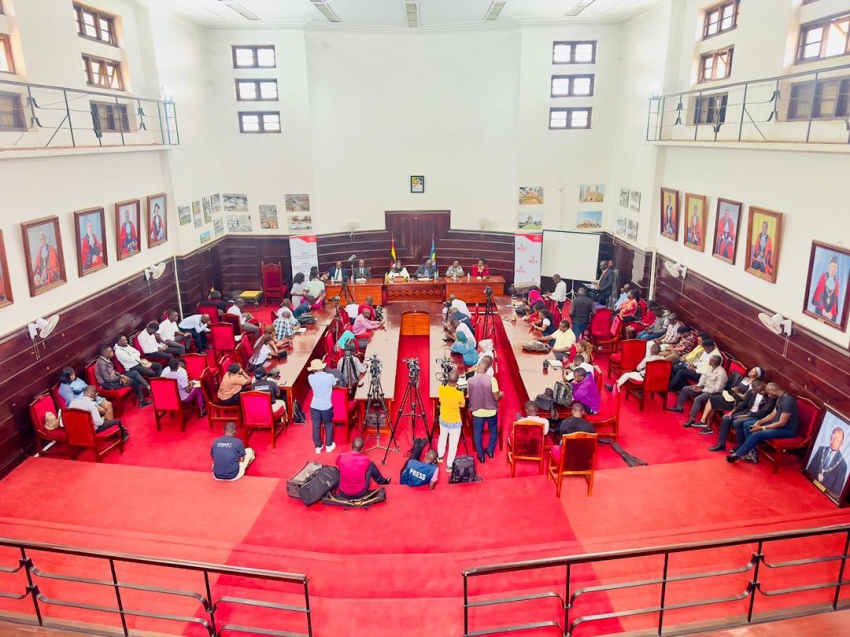
Kampala Capital City Authority wrapped up 2025 with major gains in solid waste management, road construction, flood control, and revenue collection, Executive Director Sharifah Buzeki said Monday during an end-of-year media briefing at City Hall.
Buzeki who was flanked by her deputy, Benon Kigenyi and other directors framed 2025 as a year of “action over announcements,” saying the authority prioritized delivery amid rapid urban growth, mounting pressure on services and rising public expectations.
“Growth brings waste, flooding, congestion and demand for services and dignity,” she said. “We chose systems over slogans.”
A key milestone, Buzeki said, was progress on compensating families affected by the Kiteezi landfill disaster.
KCCA secured UGX 4.3 billion for compensation and has paid 73 of 96 verified beneficiaries, with all assessments conducted by the Office of the Government Valuer and payments made directly to bank accounts.
In waste management, KCCA acquired 230 hectares of land in Buyala, Mpigi District, for a future integrated waste management and resource recovery facility. The land was purchased at UGX 70 million per acre and fully registered in KCCA’s name, she said, positioning the city for a long-term solution beyond Kiteezi.
Waste collection coverage increased from 53% to 63%, while 10 acres at the Kiteezi site are being stabilized using Fukuoka technology through a $1 million partnership with the government of Japan and UN-Habitat. Under the Weyonje sanitation campaign, KCCA reached 133,000 households with door-to-door education on waste sorting and recycling.
Roads, traffic and flood control
On transport infrastructure, Buzeki said more than 80 kilometers of roads are being rehabilitated or nearing completion under the Kampala City Roads Rehabilitation Project (KCRRP), including Old Mubende, Wamala, Kabega, Kigala and Luwafu roads. Major bridge projects also advanced, with Kayemba Bridge 95% complete and the Nakawa Railway Crossing at 90%.
Under the Greater Kampala Metropolitan Area Urban Development Program (GKMA-UDP), 15 roads totaling nearly 20 kilometers were launched. Separately, government funding of UGX 550 billion will upgrade 87 kilometers of roads over three years, with 14 kilometers already under construction in 2025.
Traffic management improvements included completion of the Kampala Traffic Control Centre, signalization of 27 junctions and removal of five roundabouts. Average travel time improved to about four minutes per kilometer, with a target of three minutes under KCCA’s strategic plan.
Flood mitigation works focused on drainage upgrades in flood-prone areas including Bwaise, Kansanga, Ggaba and Kalerwe, alongside desilting of major channels such as Nakivubo.
An inter-agency team now oversees Nakivubo Channel development, while KCCA has begun supporting landlords to improve internal drainage within buildings.
Schools, markets and public spaces
KCCA expanded public amenities by constructing 59 new public toilets and renovating 14 others in schools, markets and public spaces. Education infrastructure projects included new classrooms at Nakivubo Primary School, renovations at Munyonyo Primary School, asbestos removal at Kololo Senior Secondary School and Kyambogo College, and progress at Kasubi, Mpererwe and Bukasa primary schools.
In markets and trade order, Busega Market was commissioned to accommodate more than 2,000 vendors, while construction continued at Kiseka and Kitintale markets. Fifteen of 17 city markets are now fully registered under a “one stall, one vendor” system, and 78 private markets have been profiled and sensitized on the Markets Act, 2023.
Poverty reduction and governance
Buzeki said Kampala is now the best-performing city under the Parish Development Model. Over three years, UGX 29.3 billion has been released, with UGX 28.5 billion disbursed to more than 28,500 households across 98 parishes. Each parish has been receiving UGX 100 million annually, with President Yoweri Museveni pledging to increase that allocation to UGX 300 million per parish in recognition of Kampala’s urban demands.
Governance reforms included the launch of KCCA’s five-year strategic plan, service delivery standards and a client charter.
In July, powers were fully devolved to the city’s five divisions, strengthening local decision-making in sanitation, markets, roads and trade regulation.
In 2025, Kampala raised its annual revenue target from UGX 120 billion to UGX 132 billion, reflecting both ambition and confidence in the city’s economic potential.
By December 17, 2025, the city had collected UGX 69 billion against a target of UGX 63 billion, achieving 110% of the target, a clear sign that Kampala is on a strong financial trajectory.
Officials credited strengthened digital collection systems, reduced leakages and improved taxpayer education.
“We commend the taxpayers of Kampala, who chose compliance and partnership. Your contribution is what builds roads, keeps the city clean, improves services, and sustains growth,” Buzeki said.
Looking to 2026
For 2026, KCCA plans to complete key road projects, signalize 22 additional junctions, operationalize the Buyala landfill, upgrade nearly 48 kilometers of drainage and complete rehabilitation of 10 acres at Kiteezi. Planned social projects include completion of the Kiswa Health Centre maternity ward, construction of Ggaba Market and Usafi workspaces, delivery of 710 school desks and further upgrades at Kasubi Primary School. The authority also plans to scale up air quality monitoring and climate adaptation efforts.
Buzeki acknowledged persistent challenges, including limited waste trucks, wetland encroachment and ambulance capacity, but said the city would continue to build partnerships and enforce standards.
Addressing journalists ahead of the January 2026 elections, she urged responsible reporting and calm coverage. “When the media lowers the temperature, democracy breathes,” she said.
She also appealed to road users during the festive season to slow down and observe traffic rules, emphasizing safety.
Buzeki closed by calling for continued collaboration, saying a cleaner, safer and more livable Kampala depends on shared responsibility between city authorities, residents and the media.
By Geofrey Mutegeki Araali
Communication and Media Relations Officer
News & Announcements
28th, February 2026
27th, February 2026
26th, February 2026
25th, February 2026
19th, February 2026
17th, February 2026

15th, February 2026
13th, February 2026
12th, February 2026
11th, February 2026








Development partners